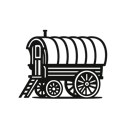
The painting is the part everyone remembers, and it followed rules. A deep body colour, most often a dark green or a red, carried the panels. Over it went the lining: fine parallel lines run freehand with a long-haired brush, following the edge of every panel and turning the corners in a flourish. Beside a thick line there is usually a thinner one, called the cut line, because two lines read better than one from the far side of a field.
Then the scrollwork. Carved and gilded acanthus scrolls on the porch brackets and the wheel hubs, running scroll along the waistboards, gold leaf laid over size and burnished. Roses, vines, grapes, birds and horses were painted onto the panels. Inside, cut and bevelled glass, mirrors and polished brass caught the light from the stove.
None of it was decoration for its own sake. A wagon was the most public thing a family owned, and the paint on it said who they were before they said a word.
The ornament used throughout this website is drawn in that tradition: gilded scrollwork, fine lining and painted chamfer bands, in the colours a wagon painter would have worked in.